
Hosting a Mahjong game at home is one of the best ways to bring friends together — and one of the most common ways people fall in love with the game. A well-run home game is relaxed, social, and genuinely fun, even for players who have never touched a tile before.
This guide covers everything you need to host your first American Mahjong night — from equipment and setup to managing different skill levels and making sure everyone leaves wanting to come back.
Step 1 — What You Need Before Anyone Arrives
The essentials
A complete American Mahjong set This is the most important item. A standard American Mahjong set includes 152 tiles, 4 racks with pushers, dice, and usually a carrying case. It will be easier to play with American Mahjong tiles if you are playing American Mahjong — American sets have at least 152 tiles including jokers and flowers. Chinese tiles only have 144 tiles, no jokers, and no numbers on the suited tiles. You can play American Mahjong on Chinese tiles, but it may confuse your guests.
One NMJL card per player Every player needs their own copy of the current year’s NMJL card — you cannot share one between four people. A new card is released every year, though as long as your whole group is playing with the same card, you can play older cards. Order from the NMJL directly.
A Mahjong mat (recommended) A dedicated Mahjong mat provides a clean, flat surface that helps keep tiles in place and enhances the overall playing experience. Not essential, but it makes shuffling quieter, prevents tiles from sliding, and gives the table a proper game night feel.
A suitable table and comfortable chairs Choose a table that is large enough to comfortably fit four players and the tiles. A square or round table is ideal. Ensure chairs are comfortable for long hours of play — cushioned chairs or adding seat pillows can make a big difference.
You do not need a dedicated Mahjong table. A standard dining table works perfectly well for a home game.
Optional but useful
- A spare NMJL card or two for beginners who want to follow along
- A printable quick-reference sheet covering tile names, Charleston rules, and Joker guidelines — especially useful for first-time players
- Betting chips or coins if you want to play with light stakes (completely optional)
- A small whiteboard or notepad to track scores across multiple games
🀄 Free Printable
Free Mahjong Cheat Sheet
New to American Mahjong? Download this free printable and keep it beside you while you play — covers the NMJL card basics, Charleston rules, and Joker guidelines.
Instant PDF • Printable • Beginner friendly
Step 2 — Setting Up the Table
Seating positions
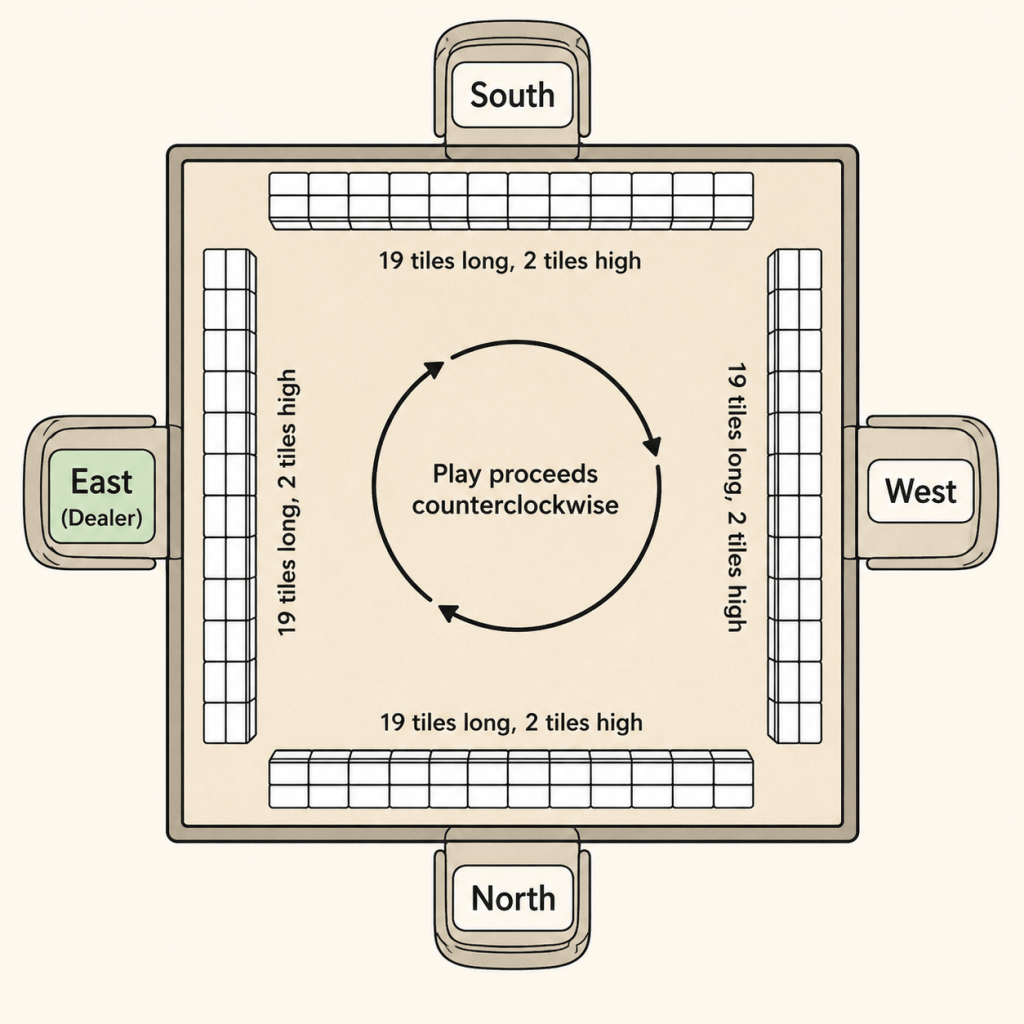
American Mahjong uses compass directions for seating: East, South, West, North. East is the dealer for the first game and sits in the seat you designate as East. The other players sit South (to East’s right), West (across from East), and North (to East’s left).
For a casual home game, seats are usually assigned by each player rolling one die — highest roll chooses their seat first.
Building the walls
Each player shuffles the tiles face-down, then stacks them into a wall — two tiles high, 19 tiles long — in front of their seat. The four walls are pushed together to form a square in the center of the table.
Learn: How to Set Up a Mahjong Table
The break
East rolls two dice and counts counterclockwise around the table to determine where the wall is broken. From that break point, each player draws tiles in turn — East draws 14, everyone else draws 13.
Step 3 — Managing Mixed Skill Levels
Most home games include a mix of experienced players and beginners. Here is how to make it work for everyone.
Before the game
Tell guests in advance which version of Mahjong you are playing. “We’ll be playing American Mahjong using the current National Mahjong League Card” sets clear expectations and lets guests prepare.
If you have complete beginners coming, send them a brief guide or the link to your rules pages so they arrive knowing the basics — it saves everyone 20 minutes of explanation at the table.
Designate an experienced player as the table referee
It helps to have the most experienced player at the table available to help with instruction and explanation throughout the game — someone who can make official calls when questions or disputes come up. This is usually the host.
Slow the game down for beginners
Give new players extra time to look at the card, especially during the Charleston. Experienced players at the same table will find this comfortable — most Mahjong players remember being beginners themselves and are happy to be patient.
Allow card consultation at all times
In casual home games, players should be able to look at the NMJL card as often as they need to. Only in competitive play is this ever discouraged — at a home game, constant card consultation is completely normal and expected.
Consider a practice round
For groups where everyone is new, a short practice round — playing without real stakes, talking through decisions openly — is one of the fastest ways to get everyone comfortable before starting a proper game.
Step 4 — Table Etiquette for a Home Game
American Mahjong has its own customs and courtesies. Following these makes the game run more smoothly and keeps the atmosphere relaxed.
Name your discards aloud. When you discard a tile, say its name — “three Bam,” “East Wind,” “Soap.” This helps all players track what has been discarded and keeps the game transparent.
Don’t touch tiles that aren’t yours. Once a tile is discarded and named, any player may call it — but no one should handle tiles that belong to another player’s rack or the walls unless the rules require it.
Jokers cannot be passed in the Charleston. This is an NMJL rule. If a Joker is accidentally passed, the receiving player must return it immediately. Remind any beginners of this before the first Charleston.
Wait for the discard to be fully named before calling it. Don’t jump in before the discarding player has finished naming the tile — it’s both courteous and often required by tournament rules, which many home games follow informally.
Keep your tiles behind your rack. Other players should not be able to see your hand. This is especially important when playing with beginners who may not realise they’re exposing their tiles.
Calling Mahjong — verify before celebrating. When a player declares Mahjong, they should lay their tiles out for everyone to verify against the card before the hand is officially won. An invalid Mahjong declaration is a dead hand.
Step 5 — Food and Drinks
Mahjong is a social game — food and drinks are part of the experience. Here is what works well for a home game:
Easy nibbles that don’t require utensils. Greasy or sticky fingers and Mahjong tiles don’t mix well. Serve what you feel comfortable making. If you love to cook, pull out all the stops. If you are less comfortable cooking, finger foods, cheese boards, and light snacks work perfectly for an evening game.
Drinks in cups with lids or handles. Spilled drinks near a Mahjong set are a nightmare. Keep drinks away from the tile area when possible, or use cups that are harder to knock over.
Small plates and napkins. Players will be eating between turns — small plates that can sit beside the rack without crowding the table keep things manageable.
Tea is traditional. If you want to lean into the cultural heritage of the game, a pot of tea on the table fits perfectly. Practically, it is also ideal — warm, easy to sip slowly, and doesn’t stain tiles if spilled.
Step 6 — How Long Will a Home Game Last?
A single round of American Mahjong (four games, rotating East) takes roughly 60–90 minutes with experienced players and 90–120 minutes with beginners or mixed groups.
A typical home game night runs two rounds — about 3 hours including time for food, conversation, and getting settled. If you are hosting beginners, build in extra time and don’t rush.
Step 7 — After the Game
Rotate East for the next round. After four games, the East position moves one seat counterclockwise and a new round begins.
Track scores if you want to. For casual play, most home games track scores across the full evening to find an overall winner. A simple notepad works fine — no special scoring app is needed.
End on a positive note. The best home Mahjong games end with everyone already talking about the next one. Keep the atmosphere light, congratulate the winner without making losses feel bad, and let the social side of the game do its work.
Hosting With Beginners — Quick Checklist
Before your first game night with new players:
- ✓ Send them a rules overview in advance
- ✓ Have one NMJL card per player
- ✓ Prepare a quick-reference sheet for tile names and Charleston rules
- ✓ Plan for a slower game — 2 hours minimum for a mixed group
- ✓ Designate yourself or another experienced player as the table referee
- ✓ Have a practice round ready if needed
- ✓ Keep snacks simple and away from the tiles
📘 Beginner Guide
NMJL Beginner Starter Kit
Hosting new players? This printable kit helps beginners follow the card and the Charleston from the first game.
- How to read the NMJL card, step by step
- A printable Charleston flowchart
- A one-page quick reference for the table
35-page printable PDF · 10% off applied at checkout · Not affiliated with the NMJL
What to Buy Before Your First Home Game
If you are starting from scratch, here is the short shopping list:
- American Mahjong set with 152 tiles, racks, and pushers
- NMJL cards (one per player)
- Mahjong mat (optional but recommended)
- Comfortable chairs or seat cushions for a long session
👉 Best American Mahjong Sets — Tested & Ranked