Before you can read the NMJL card, choose a hand, or play your first game, you need to know your tiles.
American Mahjong uses 152 tiles divided into several categories. Once you recognise each type and understand what it does, the rest of the game starts to make sense.
This guide covers every tile type used in American Mahjong — what it looks like, what it’s called, how many are in a set, and how it connects to the NMJL card.
How Many Tiles Are in an American Mahjong Set?
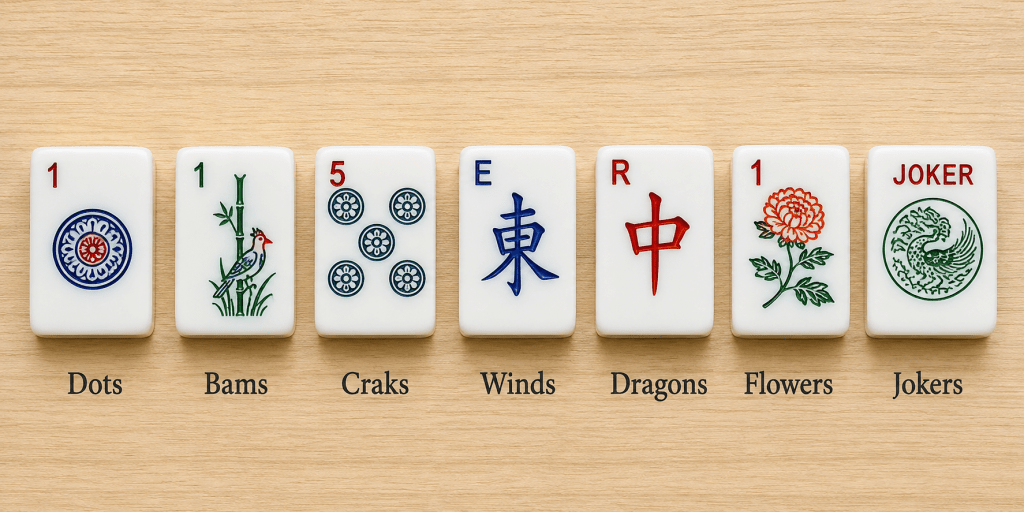
A full American Mahjong set has 152 tiles: three suits (Dots, Bamboo, Characters) numbered 1–9, plus Winds, Dragons, Flowers, and Jokers.
| Tile Type | Number in Set |
|---|---|
| Dots (1–9, × 4) | 36 |
| Bams (1–9, × 4) | 36 |
| Craks (1–9, × 4) | 36 |
| Winds (4 directions, × 4) | 16 |
| Dragons (3 types, × 4) | 12 |
| Flowers | 8 |
| Jokers | 8 |
| Total | 152 |
This is different from Chinese Mahjong, which uses 144 tiles and has no Jokers. The 8 Jokers are what make American Mahjong unique — and they are essential for NMJL play.
🀄 Free Printable
Free Mahjong Cheat Sheet
Keep a quick tile reference beside you while you play. Covers the NMJL card basics, Charleston passing rules, and Joker guidelines — everything you need for your first games.
Instant PDF • Printable • Beginner friendly
The Three Suits — Dots, Bams, and Craks
The three suits are the backbone of every Mahjong hand. Each suit runs from 1 to 9, and there are 4 copies of every tile — giving you 36 tiles per suit and 108 suited tiles in total.
Dots (Circles)
Dots tiles show circles — one circle for the 1-Dot, two for the 2-Dot, and so on up to nine. They are the easiest suit for beginners to read because you simply count the circles.
On American tiles, the suit is often marked with the letter D.
On the NMJL card, Dots are used in many hand categories and their matching Dragon is the White Dragon (also called Soap).
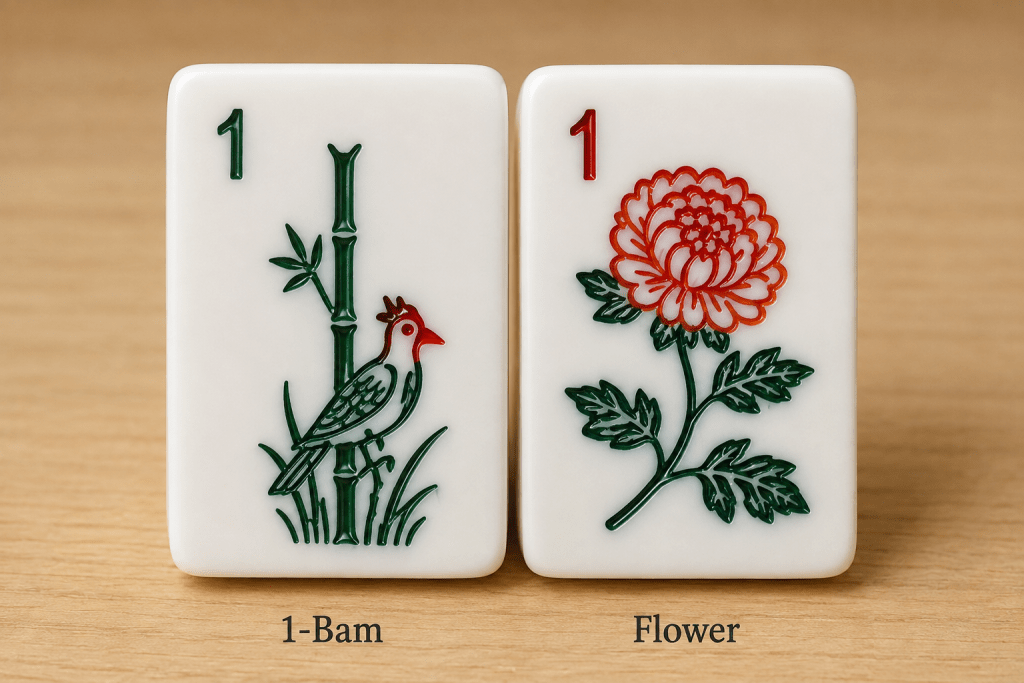
Quick tip: The 1-Dot often has a decorative design rather than a plain circle. Don’t confuse it with a Flower tile.
Bams (Bamboo)
Bams tiles show bamboo sticks. The 2-Bam through 9-Bam each show the corresponding number of bamboo sections stacked vertically.
The 1-Bam is unique — it traditionally depicts a bird (a sparrow or peacock) rather than a single bamboo stick. This is one of the most common sources of confusion for new players. If you see a bird on a tile, it is the 1-Bam.
On American tiles, the suit is marked with the letter B.
The matching Dragon for Bams is the Green Dragon.
Craks (Characters)
Craks tiles show a large Chinese character at the bottom and an Arabic numeral at the top. The character represents the Chinese word for “ten thousand” — but you don’t need to read Chinese to play. Just look at the number at the top.
On American tiles, the suit is marked with the letter C.
The matching Dragon for Craks is the Red Dragon.
Quick tip: Craks are the easiest suit to mix up at a glance because the tiles look similar. Always check the number at the top.
Honor Tiles — Winds and Dragons
Honor tiles have no suit and no number. They are used in specific hand patterns on the NMJL card and appear in most hands under the Winds and Dragons (W/D) category.
Winds
There are four Wind tiles: East, South, West, and North — often abbreviated on the NMJL card as NEWS (a helpful memory device).
There are 4 copies of each Wind, giving you 16 Wind tiles in total.
Winds are used in many NMJL hand patterns and are particularly common in hands that call for a pung (three identical tiles) or kong (four identical tiles) of a single Wind direction.
Dragons
There are three Dragon tiles:
Red Dragon — pairs with the Craks suit. On the NMJL card it is often listed as R or Red.
Green Dragon — pairs with the Bams suit. On the NMJL card it is often listed as G or Green.
White Dragon (Soap) — pairs with the Dots suit. On the NMJL card it is often listed as W, White, or Soap. It can also represent zero (0) in certain NMJL hands — this is one of the most important things to know about the White Dragon.
There are 4 copies of each Dragon, giving you 12 Dragon tiles in total.
Flowers
American Mahjong sets include 8 Flower tiles. Unlike Chinese Mahjong where flowers are bonus tiles, in American Mahjong flowers are full playing tiles used in hands on the NMJL card.
Flower tiles typically come in two sets of four — often numbered or themed differently from each other (for example, Spring/Summer/Autumn/Winter or four different floral designs).
On the NMJL card, Flowers are represented by the letter F.
Flowers do not need to match each other in most hands — any Flower counts as a Flower tile unless the hand specifically calls for a particular group. Always check the hand carefully.
Jokers
Jokers are what make American Mahjong unique and significantly more beginner-friendly than other versions.
There are 8 Joker tiles in a standard American Mahjong set.
What Jokers can do:
- Substitute for any tile in a group of 3 or more (pung, kong, quint, or sextet)
- Be used in any suit or honour group
What Jokers cannot do:
- Be used in a single tile
- Be used in a pair
The Joker swap rule: If a player has a Joker in an exposed section of their hand, any other player who holds the natural tile the Joker is replacing can swap it out. To swap, draw your tile first, then make the exchange, then discard.
Joker management is one of the most important skills in American Mahjong. Knowing when to use a Joker versus when to hold one for a more valuable position separates beginners from experienced players.
👉 Full guide: How to Use Jokers in American Mahjong
How Tiles Connect to the NMJL Card
Understanding your tiles is the foundation — but tiles only make sense in the context of the NMJL card.
The card tells you exactly which tile combinations form valid winning hands for that year. Every hand on the card is built from the tiles above — suited tiles, Winds, Dragons, Flowers, and Jokers.
Once you can look at a tile and instantly know what it is, reading the card becomes much faster.
The NMJL card uses these abbreviations:
- D — Dots
- B — Bams
- C — Craks
- N, E, W, S — North, East, West, South (Winds)
- R, G, W/Soap — Red, Green, White Dragon
- F — Flower
- JJ — Joker pair (in rare cases)
👉 Full guide: How the NMJL Card Works
American Mahjong Tiles vs Chinese Mahjong Tiles
| Feature | American Mahjong | Chinese Mahjong |
|---|---|---|
| Total tiles | 152 | 136–144 |
| Jokers | 8 | None |
| Flowers | 8 (used in play) | 8 (bonus tiles, optional) |
| Tile markings | Letters + Arabic numerals | Chinese characters only |
| Tile size | Larger (~32mm) | Smaller |
| Matching Dragon rule | Each suit has a matching Dragon | Not used the same way |
Common Tile Confusion — Beginner FAQs
What is the 1-Bam?
The tile with a bird on it. It is not a Flower — it is the 1-Bam and counts as a Bam in every hand.
What is Soap?
Soap is the White Dragon. It can represent zero in certain NMJL hands and always pairs with the Dots suit.
Do Flowers need to match?
In most NMJL hands, no — any Flower counts as F. Check each hand carefully.
Can I use a Joker in a pair?
No. Jokers can only be used in groups of 3 or more tiles.
How many of each tile are there?
4 of every suited tile (1–9 in each of 3 suits), 4 of each Wind, 4 of each Dragon, and 8 each of Flowers and Jokers.