
Every Mahjong guide talks about “the wall,” “breaking the wall,” and “East dealing the tiles” — but almost none of them explain how to actually get from a box of tiles to a table that’s ready to play. This guide fills that gap.
These steps cover standard 4-player American Mahjong setup. If you’re playing 2-player Siamese Mahjong, the process is different — no walls, no dice, self-dealt hands — see our Siamese Mahjong Rules guide instead.
What You’ll Need
- A complete Mahjong set — see Mahjong Tiles Explained if you’re not yet familiar with what’s in the box
- Four racks (one per player)
- A pair of dice
- The current year’s NMJL card, one per player
- A table with enough room for a tile square in the middle
If you’re setting up your first game night and want the full picture beyond just the table setup, see How to Host a Mahjong Game.
🖨️ Free Printables
Print a Score Sheet or House Rules Card
Make a score sheet, a house-rules card or a payout card for your table, then print it or save it as a PDF.
Free • Customize before printing • No sign-up
Step 1: Wash the Tiles
Turn all 152 tiles face down in the middle of the table and mix them thoroughly with your hands for about a minute. This is often called “washing” the tiles — it’s the Mahjong equivalent of shuffling a deck of cards, and every player usually joins in.
Step 2: Build the Wall
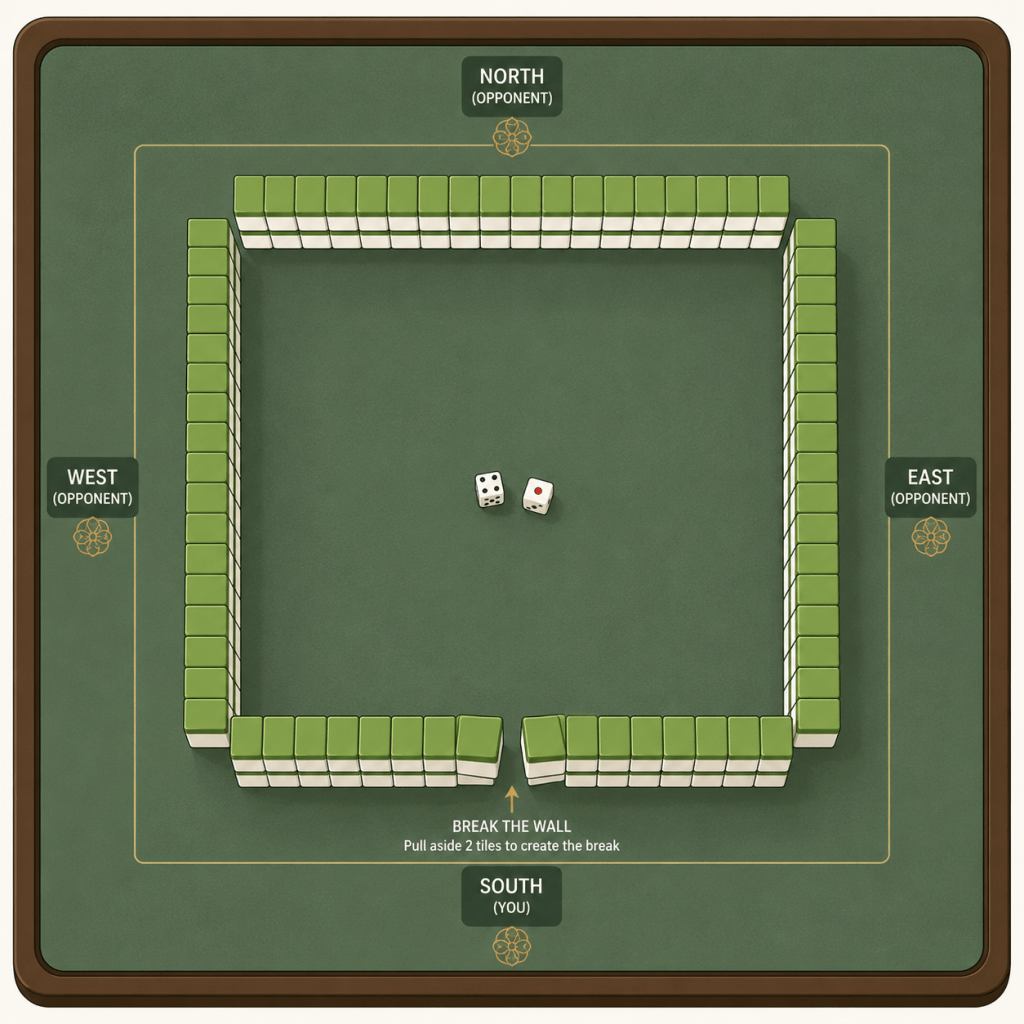
Each player stacks their own section of wall directly in front of their rack:
- 19 stacks long, 2 tiles high (38 tiles per player, 152 total)
- Tiles stay face down throughout
Once everyone’s wall is built, push all four walls together toward the center so their corners meet, forming a closed square. Leave no gaps — beyond the superstition about it, a gap makes it easy to miscount later when the wall is broken.
Step 3: Roll for East
Every player rolls the dice once. Whoever rolls the highest total becomes East — the dealer for the first hand. The seat to East’s right becomes South, then West, then North, going counter-clockwise.
East holds the deal for the round; in future hands, the deal passes counter-clockwise to the next player.
Step 4: Break the Wall
East rolls the dice again. Whatever number comes up, East counts that many stacks (not single tiles) along their own wall, starting from the right-hand end and moving left. At that point, East separates the wall — this is called “breaking” it, and it’s the equivalent of cutting a shuffled deck.
Example: if East rolls a 6, they count 6 stacks in from the right side of their wall and split the wall there.
Step 5: Deal the Tiles
Dealing moves counter-clockwise starting from the break point:
- Starting at the break, each player takes 2 stacks (4 tiles) at a time, in turns, until every player has 12 tiles.
- East then takes one more stack (2 tiles) — giving East 14 tiles.
- Each other player takes one more single tile — giving them 13 tiles each.
Once dealt, everyone arranges their tiles on their rack, hidden from the other players. East, holding 14 tiles, discards first to begin play.
🀄 Setup Down — Now Learn the Rules
Once your table’s set up, the next step is understanding how a hand is actually played. Grab the free cheat sheet to keep beside you at the table.
Download the Free Cheat SheetA Note on Push-Outs
As the game progresses and a player’s own wall runs low, the wall is pushed toward the center so players can keep drawing. Walls are used up in turn order — once East’s wall is exhausted, the game continues drawing from the next player’s wall, moving counter-clockwise around the table.
Frequently Asked Questions
Do all four walls get used, or just East’s?
All four eventually get used. As each player’s wall is drawn down over the course of the game, the game moves to the next wall in counter-clockwise order.
What if my group doesn’t want to build physical walls every round?
Some casual groups skip full wall-building for speed and simply deal from a shuffled, face-down pile instead. It’s a valid house rule as long as everyone’s using the same method, though it isn’t the standard American Mahjong procedure described above.
Does the dealer change every round?
Yes. After the first hand, the deal passes to the next player counter-clockwise, and that player becomes the new East for the following hand.
What if I’m playing with only two people?
Standard wall-and-dice setup is for four players. For two, see our dedicated Siamese Mahjong Rules guide — it skips walls and dice entirely.