
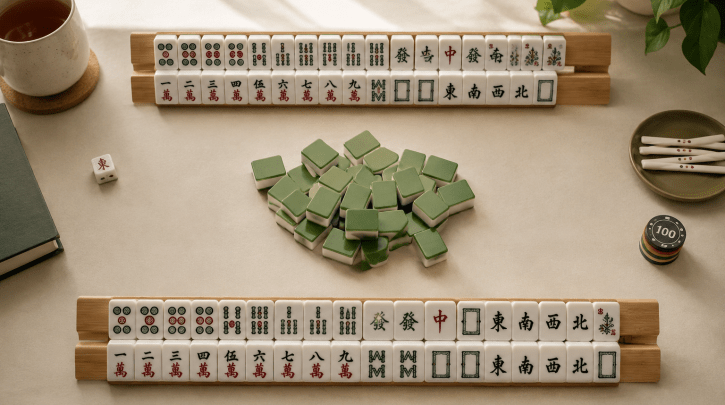

Ever wanted to play Mahjong but only had one other person around? That’s exactly what Siamese Mahjong was built for.
Siamese Mahjong — also called 2-Player Mahjong — is a variation of American Mahjong designed for exactly two players. Instead of one hand each, both players build two hands at once, using two racks side by side. It still uses the NMJL card, so if you already know standard American Mahjong, you already know the hands — you’re just learning a new format.
It’s a great option for couples, for practicing card patterns without rounding up three other players, or for squeezing in a game when your usual group is short a seat.
What You’ll Need
- One standard American Mahjong tile set
- Two racks per player (four racks total), or a double-length “Siamese rack” per player if you have one
- The current year’s NMJL card
- Two players
🀄 New to the NMJL Card?
Grab the free Mahjong Cheat Sheet before your next Siamese game — covers card basics, Jokers, and scoring at a glance.
Download the Free Cheat SheetHow Siamese Mahjong Setup Works
Siamese strips out a few steps that normally take the longest in a 4-player game:
- No walls. Instead of building and breaking walls, simply turn all the tiles face down and mix them in the center of the table.
- Two racks each. Sit facing your opponent and place two racks in front of you, one behind the other. Each rack will hold a separate, independent hand.
- Self-deal. There’s no dealer distributing tiles. Both players draw their own tiles directly from the face-down pile in the middle.
- Uneven draw. One player (acting as “East”) draws 28 tiles; the other draws 27. East’s extra tile means East discards first.
- No Charleston. Because you’re already holding double the tiles across two hands, there’s no passing round. Some players still do a single optional courtesy pass between opponents, but it isn’t required — see our Charleston guide if you want a refresher on how it normally works in the 4-player game.
🀄 Don’t Have a Second Player or a Set Handy?
I Love Mahj has a dedicated Siamese mode — play 2-player Mahjong online against a friend or the app, no tiles or racks required.
Try Siamese Mode on I Love MahjPlaying a Turn
Once tiles are drawn, gameplay will feel familiar if you’ve played standard American Mahjong:
- East discards first, from either rack.
- Your opponent can either draw a tile from the center pile or call your discard to complete an exposure — same calling rules as regular play.
- Play continues back and forth, drawing from the shrinking center pile instead of a wall.
- You can move tiles freely between your own two racks at any time. This is the part that makes Siamese strategically interesting: a tile that’s dead weight on one hand might be exactly what you need on the other.
- Exposures (Pungs, Kongs, Quints) must stay attached to the hand they belong to — you can’t move an already-exposed set from one rack to the other.
How to Win
This is the biggest rule difference from standard Mahjong: you must complete both hands to win. Getting Mahjong on a single rack isn’t enough on its own.
A few things worth knowing:
- You can choose to call “Mahjong” on just one of your two hands before your second is finished. Players usually do this for one of two reasons: it locks in any exposed Jokers so your opponent can no longer exchange them, or it lets you call a discard to complete a single or a pair — something you normally can’t do unless it’s your winning tile.
- Once a hand is called and exposed, the Jokers in it are frozen and can no longer be traded.
- The game ends the moment one player has both hands Mahjong’d — or, if the center pile runs out first with no winner, it’s ruled a wall game, same as in standard play.
Jokers in Siamese Mahjong
Jokers behave mostly as they do in standard American Mahjong, with two Siamese-specific wrinkles:
- Jokers can be exchanged from either player’s exposures — yours or your opponent’s — as long as that exposure isn’t already part of a completed Mahjong.
- Because you’re managing two hands, it’s common to end up holding a Joker that’s useless on one rack but valuable on the other. Move it over rather than holding onto it.
Strategy Tips for Siamese Mahjong
- Pick two hands that don’t compete for the same tiles. If both racks want the same suit or the same numbers, you’ll spend the whole game fighting yourself instead of your opponent.
- Use your weaker hand as a discard buffer. Set aside a couple of tiles you don’t need on either hand so you always have a “safe” discard ready — Siamese games run longer than standard games, and slow turns add up.
- Watch which exposures you make first. An early exposure reveals part of your hand and can telegraph what you’re collecting on the other rack too, since a sharp opponent will read both racks together.
- Don’t rush to call Mahjong on one rack unless you have a specific reason to. Once it’s exposed, those tiles — and any Jokers in them — are locked, which can limit your flexibility on the hand you still need to finish.
Siamese vs. Standard American Mahjong: Quick Comparison
| Standard (4-Player) | Siamese (2-Player) | |
|---|---|---|
| Players | 4 | 2 |
| Hands per player | 1 | 2 |
| Walls | Built and broken | None — draw from center pile |
| Charleston | Required | Not used |
| Dealing | Dealer distributes | Each player self-draws |
| Win condition | Complete your one hand | Complete both hands |
Frequently Asked Questions
Can I play Siamese Mahjong with the current NMJL card?
Yes — Siamese uses the same official card as standard American Mahjong. No special card is needed.
Is there a version for 3 players?
Yes, it’s called Royale Siamese and follows similar principles with an extra set of tiles and racks. It’s worth its own guide down the line.
Do I need special racks?
Two standard racks per player work fine. Double-length “Siamese racks” exist and are convenient, but they’re not required to play.
Is Siamese a good way to learn Mahjong as a beginner?
It’s better suited to players who already know the basics of American Mahjong rules and want more reps with the card. If you’re brand new, start with our Mahjong Rules Explained guide first.
